
Why Non-Profits Should Consider Muin: One Platform Instead of Five
Non-profits juggle 5-7 tools for operations. Muin consolidates donors, accounting, communications, and compliance into one platform.

Names and scenarios in this article are illustrative, not real customer stories. They represent common patterns we hear from non-profit leaders.
Ask any non-profit operations director how many software tools their organization uses, and watch them start counting on their fingers. The answer is almost always between five and seven — and that is just the paid subscriptions. Add in the spreadsheets, shared drives, and email threads that fill the gaps, and the real number is closer to a dozen.
This tool sprawl is not a minor inconvenience. It is a fundamental drag on organizational effectiveness. Every additional tool means another login, another data silo, another monthly bill, and another integration to maintain. For non-profits operating on thin margins with small teams, the cumulative cost — in both dollars and time — is staggering.
The Typical Non-Profit Tool Stack
Here is what we see most often when we talk to non-profit leaders:
| Function | Common Tool | Monthly Cost |
|---|---|---|
| Donor Management | Bloomerang, Little Green Light, DonorPerfect | $99-349/mo |
| Accounting | QuickBooks Online, Xero | $30-90/mo |
| Email Marketing | Mailchimp, Constant Contact | $20-300/mo |
| Forms & Surveys | Google Forms, Typeform | Free-$75/mo |
| Event Management | Eventbrite, GiveSmart | Per-event fees |
| Compliance/Grants | Spreadsheets, Fluxx | Free-$500/mo |
| Communication | Slack, email threads | $7-12/seat |
Total: $400-1,500+ per month — and that is before accounting for the staff time spent moving data between systems.
The human cost is even higher. Consider what tool sprawl actually looks like in practice:
Sarah is an ED who also serves as her nonprofit’s grant writer and de facto IT department. When a funder requests a financial report tied to program outcomes, Sarah pulls donor data from Bloomerang, financials from QuickBooks, program metrics from a spreadsheet, and assembles it all in Google Docs. That is four tools for one report — and the data is stale by the time she finishes formatting it.
Her development director exports donor lists from Bloomerang, imports them into Mailchimp for a campaign, then manually tracks responses back in the donor database. Her finance manager reconciles Eventbrite ticket sales with QuickBooks entries. Her program coordinator copies grant reporting data from spreadsheets into Word documents.
This is not what these skilled professionals should be spending their time on. Every hour spent reconciling data across systems is an hour not spent building donor relationships, writing grants, or delivering programs.
What Gets Consolidated
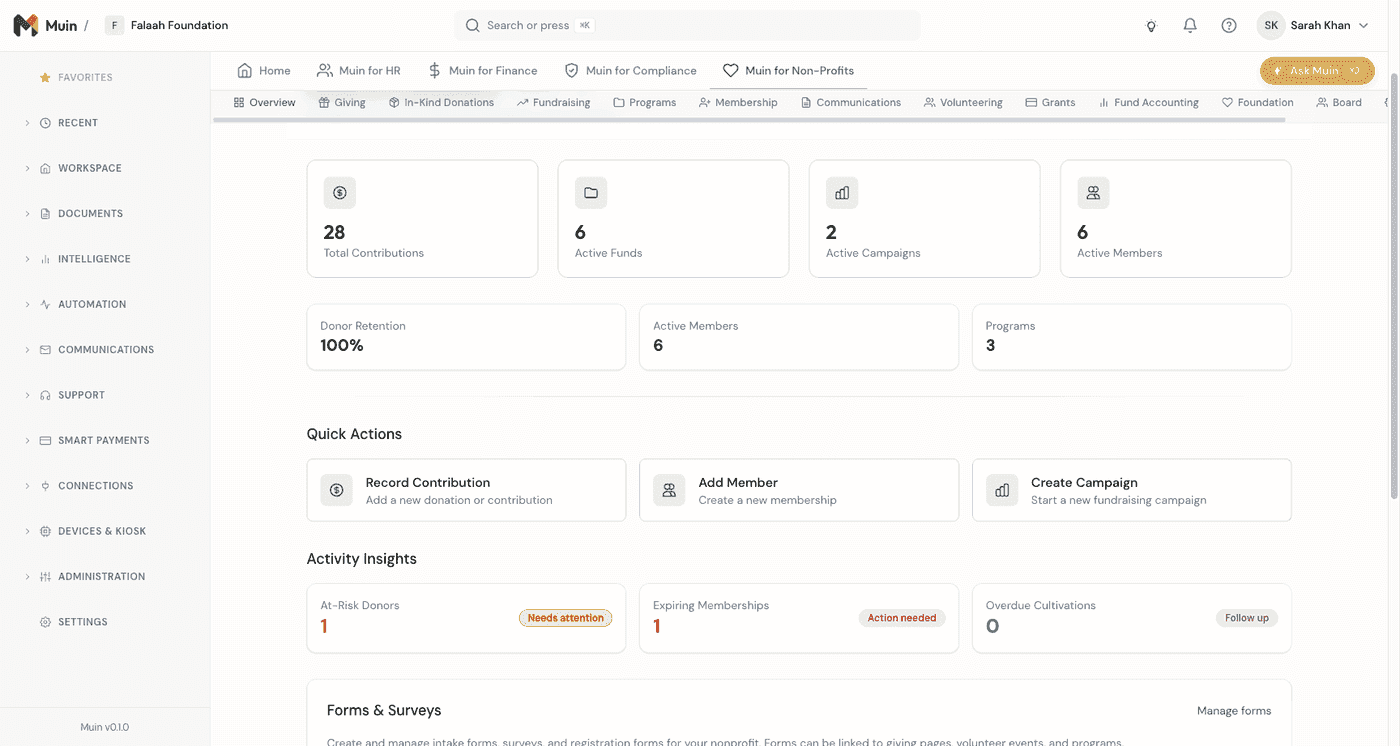
Muin consolidates the fragmented tool stack into a single platform where everything is connected. Some functions Muin replaces outright (donor CRM, forms, communications, compliance tracking). Others — payroll, accounting, payment processing — Muin integrates with the specialists you’d keep anyway. Here is how each function maps:
QuickBooks / Xero ↔ Muin for Finance (sync)
Muin for Finance handles accounts payable, accounts receivable, expense tracking, budgeting, and financial reporting — with native fund accounting for restricted, temporarily restricted, and unrestricted funds. If you already run QuickBooks Online or Xero, Muin syncs both ways through a built-in connector — keep your accounting where your CPA wants it, and use Muin’s fund-accounting and reporting layer on top. AI-powered invoice processing reads and categorizes documents automatically. Bank reconciliation connects through Plaid.
Bloomerang / DonorPerfect —> Muin for Non-Profits
The Non-Profit module provides full donor management with giving history, communication tracking, engagement scoring, and stewardship workflows. Automated tax receipts go out when donations are processed. Recurring giving management handles failed payments and renewal reminders. Campaign tracking shows which efforts drive results.
Because the donor module lives in the same platform as finance, every donation automatically appears in your accounting records. No export, import, or reconciliation needed.
Mailchimp / Constant Contact —> Communications Hub
The Communications Hub replaces standalone email marketing with multi-channel communications — email, SMS, and WhatsApp from one interface. Build drip sequences, segment your audience, and track engagement across channels. AI handles routine responses automatically.
The critical advantage: your communication tool has direct access to your donor data. Segment by giving level, last gift date, event attendance, volunteer status, or any other attribute — without exporting and importing lists.
Google Forms / Typeform —> Smart Forms
Smart Forms replace disconnected form tools with forms that understand your organization. Volunteer sign-up forms create contact records and trigger onboarding workflows. Event registration forms process payments and update attendance lists. Grant application intake forms route to the right reviewer automatically.
Returning contacts see pre-filled forms. New contacts are automatically added to your database. No manual data entry.
Spreadsheets / Manual Tracking —> Compliance Module
For non-profits managing compliance requirements — 990 preparation, grant reporting, policy tracking, certification management — the Compliance module replaces the patchwork of spreadsheets and calendar reminders with structured tracking and automated alerts.
Grant milestone deadlines trigger reminders 30, 60, and 90 days out. Document requirements are tracked per funder. Compliance evidence is collected automatically from your operations data.
The Cost Comparison
Here is what the numbers look like for a mid-size non-profit (20-50 employees, $1M-5M budget):
| Category | Current Stack (Monthly) | Muin (Monthly) |
|---|---|---|
| Donor Management | $199 | Included |
| Accounting | $60 | Included |
| Email Marketing | $100 | Included |
| Forms | $30 | Included |
| Event Tools | $75 (avg) | Included |
| Compliance | $200 | Included |
| Communication (Slack) | $84 (12 seats) | Included |
| Total | $748/mo ($8,976/yr) | Starting at $149/mo ($1,788/yr) |
That is a potential savings of up to $7,188 per year on software alone, based on published pricing as of February 2026. Muin plans start at $79/mo (Solo) and go up to $649/mo (Business) — see pricing for current plan details. Your actual savings will depend on your current tool stack, team size, and usage levels. Factor in the staff time saved from not managing integrations, reconciling data, and switching between systems, and the real impact is substantially greater than the subscription math suggests.
The Case for Consolidation
Cost savings are compelling, but the operational benefits are what non-profit leaders find most transformative:
Single Source of Truth
When a board member asks “How did our spring campaign perform?”, the answer should not require pulling data from four different systems. In Muin, every donation, communication, event registration, and expense related to a campaign lives in one place. Generate the report in seconds.
Staff Time Recaptured
Your development director should be building relationships with major donors — not copy-pasting between Bloomerang and Mailchimp. Your finance manager should be analyzing trends — not reconciling Eventbrite with QuickBooks. Your ED should be leading strategy — not serving as a human integration layer between five different platforms. Consolidation gives skilled staff back the time to do skilled work.
Fewer Integration Failures
Every Zapier connection, every API integration, every data sync between tools is a potential point of failure. When Mailchimp changes its API, your donor-to-email sync breaks. When Eventbrite updates its webhook format, your attendance tracking stops working. A single platform eliminates these failure points entirely.
Better Security
Five tools mean five sets of credentials, five data processors, five privacy policies to evaluate. Each additional vendor increases your attack surface and your compliance burden. A single platform means one set of security controls, one data processor agreement, and one audit scope.
Faster Onboarding
New staff members need training on one platform instead of five. New board members need access provisioned in one place. The learning curve drops dramatically when everything works the same way.
Making the Switch
Migrating from multiple tools to a single platform sounds daunting, but Muin provides:
- Data import tools for donor records, contact lists, and financial data
- Guided setup that walks you through configuring each module for non-profit use
- Parallel operation — run Muin alongside your existing tools during transition
- Dedicated onboarding support during the beta period
The platform is designed so that most non-profits could complete the migration in 2-4 weeks, running both systems in parallel for the first week to verify data accuracy.
Start Consolidating
If your non-profit is paying for five or more tools to manage operations, there is a better way. One platform, one login, one bill — and all your data connected.
Join the Muin beta and see what your organization can accomplish when everything works together.
Related Reading
- How a 15-Person Non-Profit Can Run Like a 150-Person Org — A day in the life before and after consolidation
- Non-Profit Fundraising in 2026 — Modern fundraising strategies with data and AI
- Your External Accountant Will Thank You — How clean data transforms 990 season
- Non-Profit Compliance and Grant Management — From grant application to audit with automated tracking
- Introducing Gusto Integration — Seamless HR data sync that eliminates manual entry