
Why Your Mosque Needs Smart Digital Giving in 2026
Cash donations are declining, digital payments are accelerating, and mosques that do not adapt will lose hundreds of thousands in missed giving. Here is what modern mosque giving looks like.

Names and scenarios in this article are illustrative composites, not real customer stories. Statistics from external sources are cited with links.
It is the last ten nights of Ramadan. The imam delivers a passionate appeal for the building expansion. The fundraising thermometer on the wall shows $180,000 of a $500,000 goal. The energy in the room is electric. People want to give.
And then: three hundred people reach for their wallets, and half of them find a phone and a debit card.
No cash. No check. No way to give.
The collection plates come back half-full. The fundraising coordinator writes down pledges on paper napkins, knowing that 40-60% of verbal pledges never convert to actual donations without an immediate payment mechanism. The imam’s emotional appeal — months in the making — converts at a fraction of its potential.
This scene repeats every Friday, every Ramadan, every fundraising dinner, at mosques across America. It is not a fundraising problem. It is an infrastructure problem.
The Numbers Are Clear
The Federal Reserve’s Diary of Consumer Payment Choice documents the accelerating decline of cash: just 14% of all US transactions use paper currency, down from 26% in 2018. For Americans under 40 — the demographic that mosques most need to engage — the number is even lower.
Meanwhile, mosque giving infrastructure has not followed the money. A congregation that can only accept cash and checks is not collecting less because it became less generous — it is collecting less because the friction between the intention to give and a way to pay it never closes.
The gap is straightforward. Every attendee who arrives without cash during an appeal is a gift that was intended and never made. Not because people do not want to give, but because there is no mechanism to accept their preferred payment method at the moment of maximum motivation — during the imam’s appeal, after a moving khutbah, or while walking through the lobby.
What “Digital Giving” Actually Means for a Mosque
Digital giving is not just replacing the donation box with a card reader. That is like saying the internet is just a faster fax machine. A properly implemented digital giving system transforms how your mosque connects with donors, manages funds, and operates financially.
Here is what the full picture looks like:
1. Capture Every Moment of Generosity
Donations peak at specific moments: during the imam’s fundraising appeal, immediately after Jumuah khutbah, during the last ten nights of Ramadan, and at iftar gatherings. These windows last minutes, not hours.
Modern kiosk systems let you meet donors in those moments with the right device in the right mode:
-
A volunteer walking through the prayer hall with a handheld device during the imam’s appeal. Donors tap their card without leaving their seat. Three seconds per transaction. No lines, no waiting, no fumbling for cash.
-
A countertop kiosk at every entrance collecting donations from everyone who walks in or out. No volunteer required. The kiosk displays the active campaign with a progress thermometer and lets donors choose their fund, enter an amount, and tap to pay.
-
A live appeal mode pushed to every device simultaneously when the imam calls out “Who gives $1,000?” — large-format ask buttons appear on every screen in the building, and volunteers fan out with handheld devices while the emotional momentum is at its peak.
2. Every Dollar Goes to the Right Fund
In a cash system, money goes into a box. Someone counts it later and allocates it based on… what, exactly? The announcements made during Jumuah? The signs on the donation box? Hope?
A digital system lets donors specify exactly where their donation goes at the moment they give. Zakat to the Zakat fund. Sadaqah to general operations. Building fund to the building fund. No manual allocation, no guesswork, no accounting headaches at year-end.
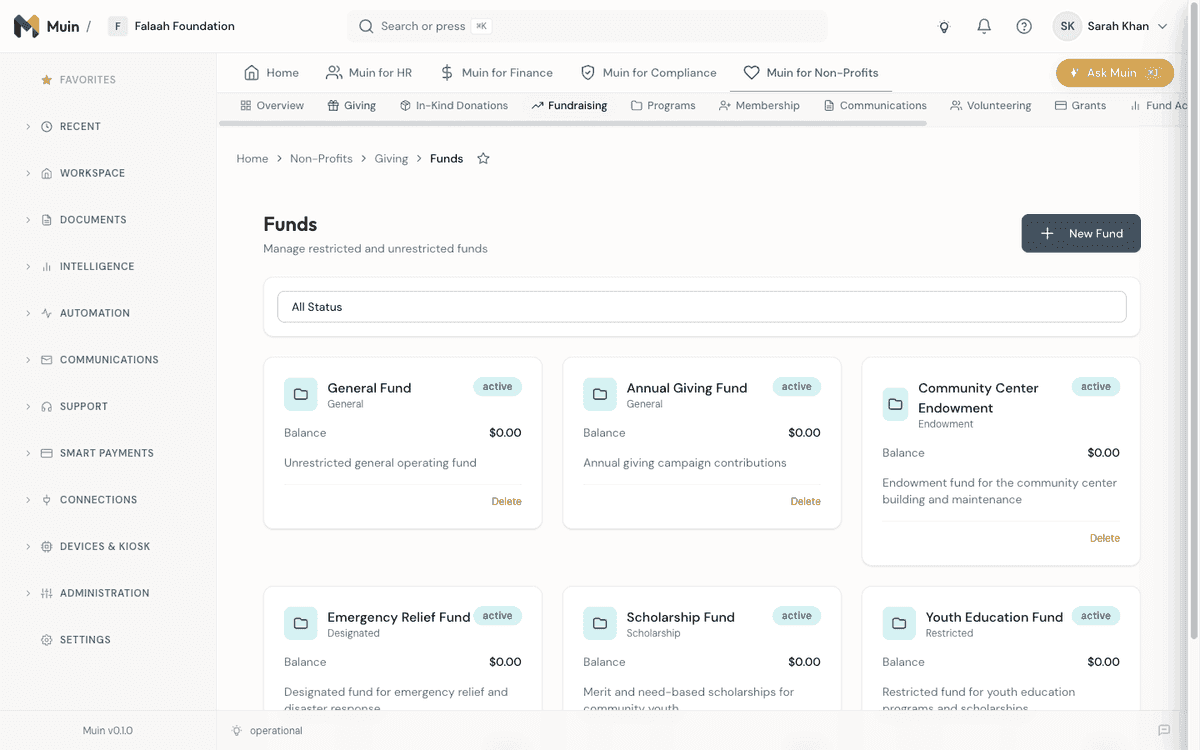
This is not just administrative convenience. It is a trust multiplier. Donors who can see that their Zakat went to the Zakat fund — and can verify it through their tax receipt — give more. They give more frequently. And they tell others.
And for Zakat specifically, Muin helps donors work out how much they owe, not only where it goes. An embeddable Zakat calculator lets a donor enter their zakatable assets — cash, gold and silver, investments, and more — and computes the 2.5% due against a nisab threshold pulled from live daily gold and silver prices. The donor sees the exact amount with an itemized breakdown and gives it on the same page. If their wealth falls below nisab, the calculator points them toward Sadaqah rather than a dead end.
3. Donors Get Receipts Without Asking
Every digital transaction generates an automatic, IRS-compliant tax receipt. Delivered instantly via email, SMS, or displayed as a QR code on the kiosk screen for the donor to scan.
No more “Can I get a receipt for my Zakat?” requests. No more year-end scrambles to issue donation statements. No more spreadsheets tracking who gave what and whether they got a letter.
For donors who itemize deductions — including those with significant Zakat obligations — immediate, accurate receipts are a material factor in choosing where to give.
4. Recurring Giving Becomes Effortless
A donor gives $50 at a Jumuah kiosk. The success screen asks: “Would you like to make this a monthly gift?” One tap, and the mosque has a $600/year committed donor instead of a $50 one-time contribution.
Research consistently shows that recurring digital donors give 2-3x more per year than one-time donors. A mosque that converts even 10% of its kiosk donors to monthly giving creates a predictable revenue baseline that enables better planning, budgeting, and program investment.
5. Cash Does Not Disappear — It Gets Recorded
Digital does not mean cashless. Older congregants, visitors, and some community members will always prefer cash. The point is not to eliminate cash but to record it in the same system as digital donations.
Modern platforms let a volunteer punch in a cash donation amount, categorize it by fund, and optionally record the donor’s name — all on the same device that processes card taps. The mosque’s financial records now capture every dollar, from every channel, in one unified ledger.
The Ramadan Multiplier
Ramadan is not just the most important month for giving in Islam — 69% of US Muslims always give to charities during Ramadan. It is the single largest revenue event for most mosques, often accounting for 30-40% of annual donations.
Every friction point during Ramadan has an outsized cost. A donor who cannot give during the imam’s appeal on the 27th night does not come back and give on the 28th. That moment is gone. That potential donation — $100, $500, $1,000 — evaporates.
Here is how a digitally-equipped mosque handles Ramadan differently:
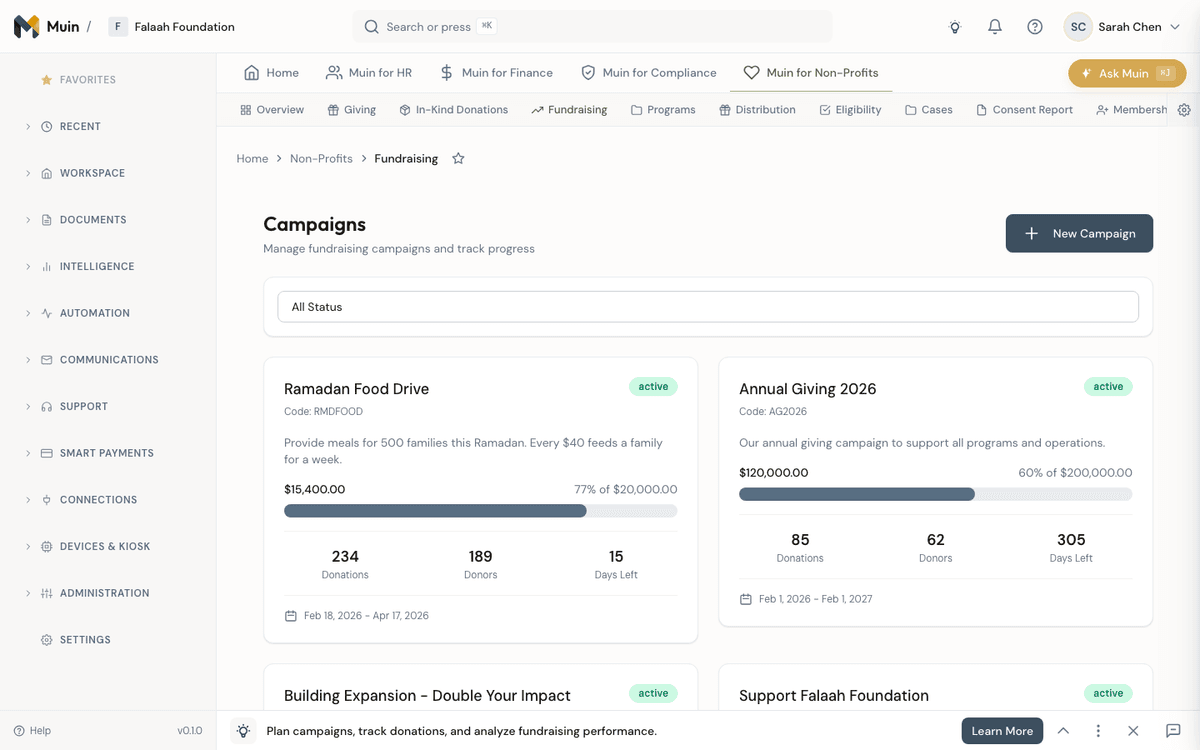
Night 1: Campaign Launch
- Create a Ramadan campaign with a goal amount and fund allocation
- Push Ramadan-themed branding to all kiosks: custom presets ($50, $100, $250, $500), Ramadan imagery, campaign progress thermometer
- Activate QR code flyers with links to the online giving page for donors who want to give from their phone at home
Night 21 (Beginning of Last 10 Nights): Peak Giving
- Switch all kiosks to Campaign Donation mode with emphasis on the building fund or whatever the focus is
- Activate the thermometer attract screen on all idle kiosks — visible from the prayer hall
- Deploy maximum handheld devices with extra volunteers
Night 27 (Laylatul Qadr): The Critical Night
- Admin activates Live Appeal mode from the dashboard
- Every kiosk and handheld device displays the current ask amount, pushed in real-time
- As the imam adjusts amounts (“Who gives $5,000? Who gives $2,500?”), the admin updates all devices with one click
- The donor wall mode on lobby kiosks shows real-time donations, creating social momentum
- Between appeal rounds, the thermometer attract screen shows progress toward the goal — “$380,000 of $500,000” — driving urgency
Night 30 (Eid): Zakat al-Fitr Collection
- Switch handheld devices to QuickPay mode at the current Fitrah rate
- Volunteers collect at entrances, in the parking lot, at the prayer space doors
- Each transaction takes 3 seconds — confirm the amount, tap to give
- The system categorizes it as Fitrah automatically based on the device configuration
Post-Ramadan:
- Complete financial report: total raised, broken down by fund, by channel (kiosk, online, QR, text, cash), by night
- Every donor has a receipt. Every dollar is accounted for. Cash still gets a two-person count; the digital channels arrive matched for you to confirm. No spreadsheets.
Beyond the Donation Box: What Else Changes
Digital infrastructure transforms more than just how you collect money. It changes how you understand, engage, and retain your community.
Know Your Donors
A cash donation is anonymous by default. You do not know who gave, how much they typically give, or whether they have been giving less often. You cannot thank them personally. You cannot identify a major donor who has stopped attending.
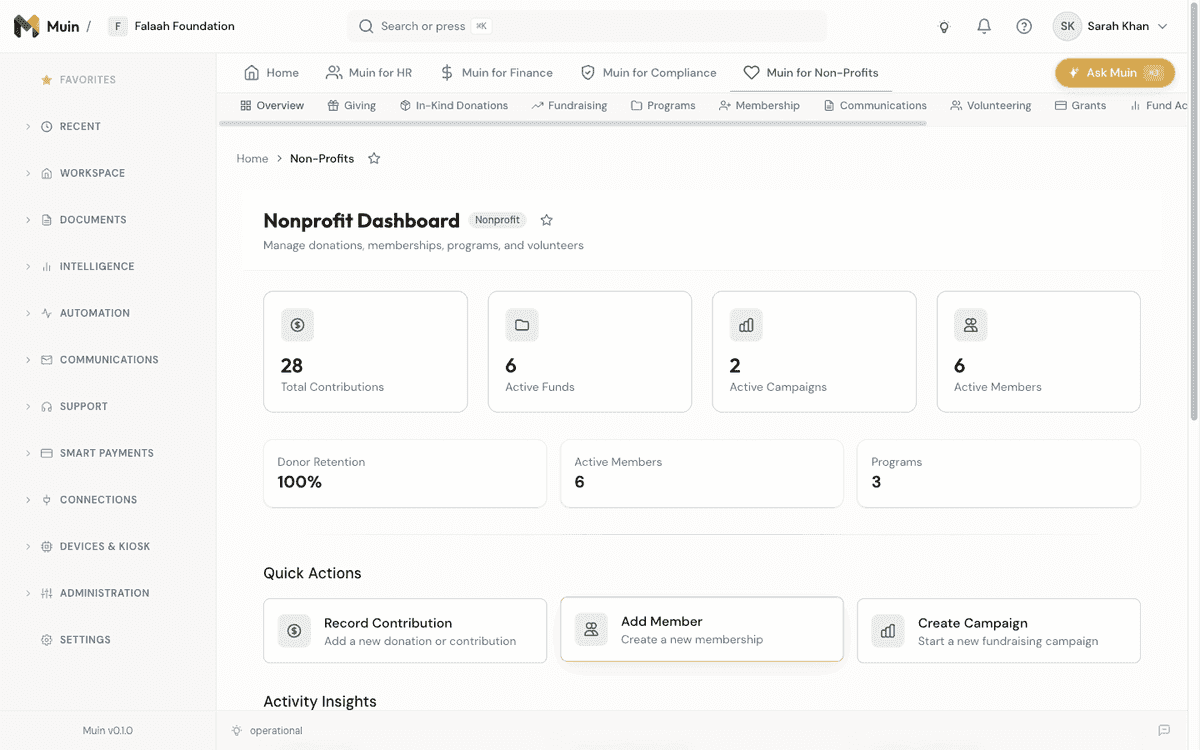
A digital system builds a donor profile over time — automatically. First name, last name, email (if provided), giving history across all channels, frequency patterns, fund preferences. The system can automatically segment donors:
- Major donors (over $10,000/year) — these need personal stewardship from the board
- Mid-level donors ($1,000–10,000/year) — engaged community members who respond to targeted appeals
- Regular donors (under $1,000/year but active) — the reliable base
- Lapsed donors (no donation in 12+ months) — people who drifted away and might come back with a thoughtful reach-out
This is not surveillance. It is stewardship. Every professional nonprofit does this. Most mosques do not — not because they do not want to, but because their cash-based systems make it impossible.
Let Donors Help Themselves
A self-service donor portal eliminates the most common administrative requests:
- “Can I get a copy of my receipt?” → Available 24/7 in the portal
- “I want to change my recurring donation amount” → Self-service
- “Can I pause my monthly giving during summer?” → One click
- “I need my year-end giving statement for taxes” → Auto-generated, downloadable
No email to the office. No phone call. No volunteer time spent on paperwork. The donor has control, and the mosque has zero administrative burden.
Make Giving Accessible Everywhere
Your mosque’s physical walls are not the boundary of your community. Members travel. Snowbirds spend winters in another state. Young professionals move for work but keep their attachment to their home mosque.
A unified giving platform means your community can give from anywhere:
- Website widget: A donation form embedded on your mosque’s website
- QR codes: Printed on newsletters, flyers, business cards, event banners
- 2-Way SMS (Growth+ plans): Dedicated toll-free number for messaging
- Social media: Share giving page links in WhatsApp groups, Instagram stories
- Donor portal: Manage recurring gifts from any browser
All of it flows into the same system, the same donor profile, the same financial reporting.
The Cost of Inaction
Let us make this concrete. Consider a medium-sized mosque with 500 regular attendees, currently collecting $150,000/year in donations — primarily cash, with some checks.
What they are losing today:
| Factor | Annual Impact |
|---|---|
| Donors who wanted to give but had no cash (estimated 30-50% of potential) | -$45,000 to -$75,000 |
| Recurring giving not captured (kiosk donors who would have gone monthly) | -$15,000 to -$30,000 |
| Lapsed donors not identified or re-engaged | -$10,000 to -$20,000 |
| Peak-moment giving lost (Ramadan appeal, Jumuah, events) | -$20,000 to -$40,000 |
| Estimated annual lost potential | -$90,000 to -$165,000 |
What a digital system costs:
| Item | Cost |
|---|---|
| 5 handheld devices (Samsung Galaxy A15 5G, renewed) | $450 one-time |
| 2 countertop kiosks (tablet + stand) | $420 one-time |
| Cases, chargers, accessories | $200 one-time |
| Transaction processing (2.2% nonprofit rate + 0.5% platform fee on $200K) | ~$5,400/year |
| Total first year | ~$6,470 |
Spend $6,470 against $90,000-165,000 of estimated missed giving. On those estimates that is a 14x-25x return. Even if the actual uplift is half of the conservative estimate, it is still a 7x return.
What Holds Mosques Back (And Why Those Concerns Are Outdated)
“Our community prefers cash”
Some members do. And they can keep giving cash — the volunteer records it on the same device. But for the growing majority who carry only cards and phones, you are asking them to change their behavior for your convenience, instead of adapting your infrastructure for their reality.
“We cannot afford the technology”
Five renewed phones at $90 each cost $450 total. Less than a single month’s utility bill. Less than the floral arrangements for last year’s Eid celebration. The technology has never been cheaper or more accessible.
“We do not have IT expertise”
Modern kiosk platforms are designed for volunteers, not engineers. Setup takes an afternoon. Management happens from a web dashboard. Devices are consumer Android phones from Amazon. If your volunteers can set up a Gmail account and a Ring doorbell, they can run a donation kiosk fleet.
“What about transaction fees?”
Yes, card processing costs approximately 2.7% per in-person transaction through Stripe (2.2% for verified nonprofits), plus Muin’s 0.5% platform fee — about 2.7% total for nonprofits. On a $100 donation, that is $2.70. But consider: a $100 card donation that actually happens is worth infinitely more than a $100 cash donation that does not happen because the donor had no cash. The question is not “does the 2.7% fee cost money?” — it is “does it cost more than the 100% of donations you are losing?”
Enable the “fee coverage” option and let donors choose to cover the fees. Most platforms report that 60-70% of donors opt in.
“Security and fraud concerns”
Digital payments are objectively more secure than cash. Cash can be miscounted, lost, or stolen between the donation box and the bank. Digital transactions are encrypted, traceable, and automatically recorded. Stripe handles PCI compliance. Device lockdown prevents tampering. Remote lock protects against theft.
Getting Started Is Easier Than You Think
You do not need board approval for a $50,000 kiosk system. You need a Tuesday evening, an Amazon order, and the willingness to try something new.
Week 1: Order 3 Samsung phones ($270) and a countertop stand ($60). Total: $330.
Week 2: Install the app. Connect to Stripe. Configure your funds (Zakat, Sadaqah, General, Building). Set preset amounts.
Week 3: Deploy at your next Jumuah. Give two phones to volunteers. Place the countertop kiosk in the lobby.
Week 4: Review the results. Adjust amounts. Add more devices if needed.
Most mosques see measurable results within the first month. Not because the technology is magical, but because removing friction from an act people already want to do produces immediate, obvious results.
The Future Is Already Here
While most mosque technology platforms are still catching up to basic NFC payments, the next wave is already arriving:
Live appeal coordination — not just a static kiosk, but real-time, synchronized fundraising across every device in the building, controlled from the admin dashboard. Start, update, and end appeals instantly — every kiosk switches to the live appeal screen in real time via WebSocket. (Mobile coordinator app and live donation totals dashboard coming soon.)
AI-powered donor insights — predicting which donors are at risk of lapsing with engagement scoring and retention analytics, so your board knows who needs a personal call before they drift away. (AI-suggested appeal amounts and optimal timing analysis coming soon.)
Unified reporting — every dollar from every channel in one system, broken down by fund and time period. Contribution tracking, donor profiles, and payment reports give you a complete picture of your giving. (Channel-level breakdowns by device, location, and campaign are coming soon.)
Endowment intelligence — full Waqf management with spending rate optimization, principal preservation tracking, and investment return accounting. Configure spending rate policies, track earnings separately from corpus, and calculate distributable amounts — all aligned with endowment best practices.
Document intelligence — AI-powered bank reconciliation that matches bank statement rows to contributions for you to confirm, and automated Form 990 / 990-PF preparation that pulls directly from your financial data. (Intelligent donor correspondence and thank-you letter automation coming soon.)
Some of these capabilities are live today. Others are in active development. All of them are built on a platform designed for this exact use case.
A Closing Thought
The donation box has served mosques well for 1,400 years. But the world your community lives in has changed. Your congregants pay for groceries with a phone tap. They split dinner bills on Venmo. They buy plane tickets from their watch. And then they walk into the mosque and find a wooden box and a hope that they remembered to stop at an ATM.
You can honor tradition without being trapped by it. A digital giving system does not replace the spirit of generosity — it removes the barriers that prevent generosity from reaching its full expression.
Your community is ready. The technology is affordable. The only question is whether you will act this Ramadan, or wait until the next one.
Related Reading
- Inside a Digital Ramadan Campaign — Blueprint for a modern, digitally-powered Ramadan
- The Complete Mosque Operations Checklist for 2026 — Every operational area your mosque needs to manage
- From Paper to Platform — A mosque admin’s digital transformation guide
- Kiosk Campaigns — Authoring giving kiosks and live campaigns in Muin